
As students protest and Sonam Wangchuk fasts for educational accountability, Bollywood’s biggest stars remain conspicuously absent. The industry’s silence raises an uncomfortable question: are its screen heroes merely manufactured illusions, questions OSWALD PEREIRA
The stage is not a film set. There are no retakes. No choreographed fights. No soaring background score announcing the arrival of the hero.
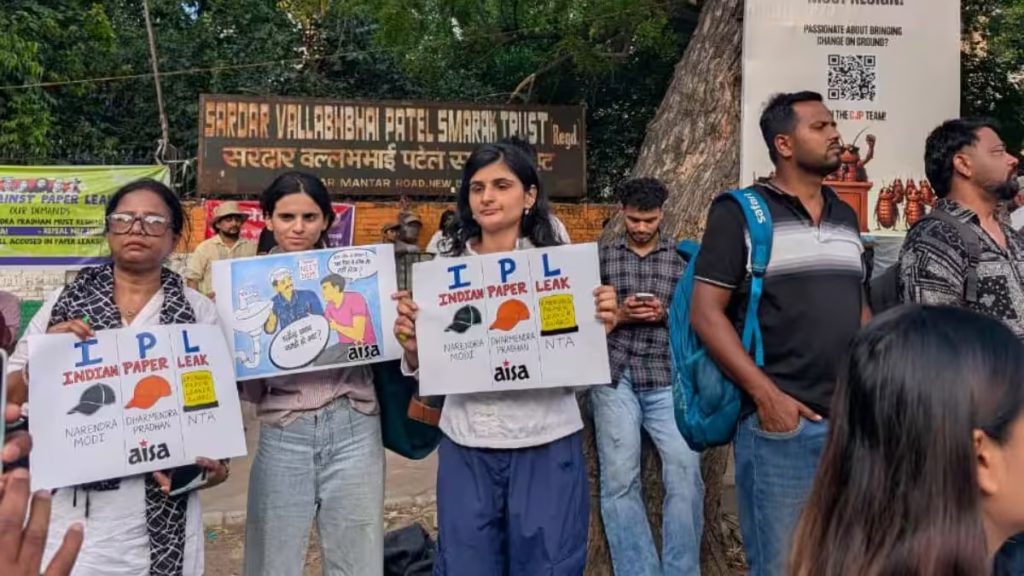
There is only the blistering sun at Jantar Mantar in New Delhi and a large gathering of determined students, citizens from every walk of life, and educationist Sonam Wangchuk, whose indefinite hunger strike has crossed ten days.
Around him gather student leaders, a few opposition politicians, lawyers, farmers, retired soldiers, elderly citizens who have travelled hundreds of kilometres, writers, artists and activists. They have come not because a director handed them a script but because their conscience prompted them to lend their support.

One by one, they arrive, while Bollywood stays away.
The protest, now stretching close to three weeks, organised by the Cockroach Janta Party, is not about a film. It concerns the integrity of India’s education system following allegations surrounding the NEET examination and the demand that Education Minister Dharmendra Pradhan accept political responsibility. One may agree or disagree with the protesters’ demands. That is the essence of democracy. Peaceful dissent is not sedition. It is citizenship in action.
Yet the country’s most influential dream factory has chosen to dream elsewhere.
The silence is especially striking because Sonam Wangchuk inspired 3 Idiots, one of the most celebrated films ever made on India’s education system. Aamir Khan played the unforgettable Rancho, the rebel who challenged conformity, celebrated curiosity and mocked an education system obsessed with marks instead of minds.

Audiences laughed. They cried. They applauded. The film earned fortunes.
Today, the man who inspired that story sits on a hunger strike. The applause has stopped. Bollywood is silent. The hero Aamir Khan, who played Sonam Wangchuk is busy celebrating his third marriage.
Bollywood continues making movies about heroes, solely with an eye on the box office.
Contrast this with Hollywood, where actors routinely risk public criticism by speaking on civil rights, war, climate change, racial injustice or humanitarian crises. Their opinions are often controversial. Many are criticised. Some lose endorsements. Yet they speak because they believe celebrity without conviction is little more than expensive decoration.
Bollywood appears to have reached the opposite conclusion. It has perfected the art of profitable neutrality.
Its stars are fearless only when the villain exists safely within the screenplay.
The irony is tragic. How spineless can our Bollywood heroes be off-screen?
Hindi cinema has built an empire by selling courage. It has produced fearless journalists exposing corruption, upright police officers confronting political mafias, revolutionaries sacrificing their lives for justice, honest bureaucrats defying powerful ministers, and ordinary citizens refusing to bow before tyranny.
The audience buys the tickets. The hero defeats evil. Justice triumphs. All in the matter of three hours.
But when the lights come on after the show, reality shows its gross, commercial face. The heroes have gone on vacation.
To be fair, actors are under no constitutional obligation to endorse protests. They are citizens, not elected representatives. They have every right to remain silent.
But silence, repeated with mathematical consistency whenever power may be inconvenienced, ceases to be neutral. It becomes calculation. It seems so cowardly.
One cannot help noticing another contrast.

Across southern India, cinema has often spilled into politics. Actors have crossed the uncertain bridge from reel life to real life, asking voters—not film critics—to judge their convictions. Some have succeeded spectacularly. Others have failed. But they entered the arena. They accepted scrutiny. They tested whether the courage they portrayed on screen could survive outside the studio gates.
Bollywood, by comparison, has largely mastered another craft: the choreography of proximity to power. Across changing governments and changing political seasons, many stars have perfected the art of being photographed with those who hold the reins of power.
That art explains the silence now.
The silence stems from fear—of losing endorsements, offending the government, inviting investigations; above all, of losing the market.

But history has never remembered those who merely protected their careers. It remembers those who endangered them.
The word hero has been devalued by overuse. Publicists confer it. Fans chant it. Producers monetise it.
History does not believe in false heroes.
History reserves that title for those who stand up for a cause, even if it carries a cost.
The tragedy is not that Bollywood has forgotten how to make heroes.
The tragedy is that somewhere between the first day’s first show and the weekend box-office collection, it seems to have forgotten the difference between acting brave and being brave.
The cameras will eventually leave Jantar Mantar.
The hunger strike will end. The government may change.
Films will break new records.
But one question will linger on: When conscience called, who stood under the scorching sun—and who quietly slipped out through the back door?
Oswald Pereira, a senior journalist, has written ten books, including The Vijay Revolution: People Power & the Politics of Hope, Beyond Autobiography of a Yogi, The Newsroom Mafia, Chaddi Buddies, The Krishna-Christ Connexion, How to Create Miracles in Our Daily Life and Crime Patrol: The Most Thrilling Stories. Oswald is a disciple of Paramhansa Yogananda, and practises Kriya Yoga.
More Stories by Oswald Pereira
Some images are AI-generated